Which Claude Model Should Review a Contract? We Tested All Four
We hid 8 traps in two software contracts and ran Haiku, Sonnet, Opus and Fable 24 times. All found all 8. Costs, list lengths and the flaw most runs missed.
Read article[ BLOG ]

Real stories, hard-earned lessons, and technical deep-dives from building compliant software for legal tech and healthcare.
We hid 8 traps in two software contracts and ran Haiku, Sonnet, Opus and Fable 24 times. All found all 8. Costs, list lengths and the flaw most runs missed.
Read article

Clio's export page gives an administrator CSV files of matters, contacts, notes, tasks, calendar, communications, time and expenses. Documents, bills, trust transactions and custom field definitions are not in it. What each gap means, where each one can be recovered, and what to do before you cancel, since Clio deletes a cancelled account's content no less than 90 days later.
Clio's built-in export gives an admin spreadsheets and leaves out documents, bills and trust transactions. Here is every way to get a complete copy of a Clio account, from the export page to the API, hosted backup tools and a free open-source command, with the steps, the limits and how long each takes.
How a lawyer turns their own method into a Claude skill, where the free legal skill libraries stop, and why a skill you share is a skill anyone can copy.
A managing partner asked Claude what was on a colleague's Clio calendar and got the browser instead. Clio's API supports it: calendar_id on entries, calendar_owner on every entry, visible and writeable on calendars. Most connectors don't ask.
A managing partner can't tell who uses Claude on Clio from five laptops. What each setup records, where the one firm-wide log lives, what Claude's own admin tools show by plan, and five questions for any vendor.
Every Monday at 7am: hours per workday per person, gap days, billable share, entry quality, unbilled time, with time off from the payroll system so a day off isn't flagged as missing time. Reads only, nothing written back.
A lawyer sorted his own skills in one sentence: anything with a yes/no gate needs a person, anything that only reads can run alone. The three-question test, his skills sorted, and what the server actually changes.
Claude already lists your day's work from calendar, email and files. The last step: posting time entries to Clio, the no-duplicate rule, and matter matching.
Projects, per-user connectors, tool approval, a connector in your own cloud. What each isolates for a four-attorney firm on Enterprise, and what does not.
A partner's words on the call. Projects, skills, bounded context, tool approval, caching, a usage view, training: what each saves and how to set it.
The anonymised 13-section scope a four-attorney firm sent us for Claude, Microsoft 365, MyCase and Lexis: what it got right, what it missed, plus a template.
Yes, licensed separately: Protégé API, content search, CourtLink, Lex Machina. What each returns, what Shepard's lacks, and the honest path for a small firm.
No app can read an iPhone's calls or texts. What does log them to Clio: Clio's own app and texting, Quo, Call Connector, VXT, Corvum, LegalMate, Time Miner.
Three connectors, one firm. What Claude reads and writes in MyCase, Lexis+ and Microsoft 365, which plan each needs, and where a mid-size firm needs help.
Filevine doesn't publish prices; every plan is a custom quote billed per user per month. Third-party trackers report $49 to $87 per user per month, implementation partners publish launch plans from $1,750 to $32,500, and the AI is metered at three chats per user per month in the base plan. Here is the 3-year math for a 15-person PI firm, what's gated behind add-ons, the exit terms, and three ways out.
Claude can be used with PHI on two surfaces: Claude Enterprise with HIPAA turned on by the Primary Owner, and the first-party API in a HIPAA-ready organization. Free, Pro, Max and Team are not HIPAA-ready plans. Cowork and Claude Code in local mode are covered once the Primary Owner applies the HIPAA configuration; Cowork in the cloud, the Console, Skills, connectors and the beta features are not. Plan by plan, re-checked against Anthropic's BAA articles on 15 October 2026.
Supabase signs a BAA on the Team plan and up, with its paid HIPAA add-on, and only for projects you configure as high compliance. Free, Pro and self-hosted Supabase get no BAA. Here is what the BAA requires, what Vercel and Lovable add to the picture, and how to put PHI behind a backend that is covered. Checked against vendor docs on 2 October 2026.
OpenAI's Astra for Law: only selected US firms in Trusted Access can use it, aimed at the Am Law 200, and a paid ChatGPT plan does not unlock it. 54% correct on OpenAI's own test, no price published. What a firm of 2 to 50 attorneys runs instead.
Three legal AI editions compared for firms under 50 attorneys: access, research index, Clio and MyCase coverage, data terms, and what you keep if you leave.
OpenAI announced 26 partner plugins and 9 community plugins with Astra for Law on 17 September 2026 and never published the full list. We collected every plugin named in public so far: 22 vendor plugins and 5 community plugins, grouped by category, each with a source. Then the gap: Clio is the only small-firm practice management system on the list, and only through Vincent. Last checked 14 October 2026.
Every AI connector advertises an audit log. Almost nobody reads one. A ten-minute diagnostic for any connector: where the file lives, the canary test that shows whether it stores content or references, why denylist redaction fails open, and the five questions worth putting to a vendor.
Clio Manage trials carry API access for about seven days. After that the token exchange returns 401 invalid_client with credentials that are perfectly correct, and Clio returns that same error for every OAuth failure it has, so it cannot tell you which one you hit. The gate is account type, not plan tier, and the fix is a free developer account.
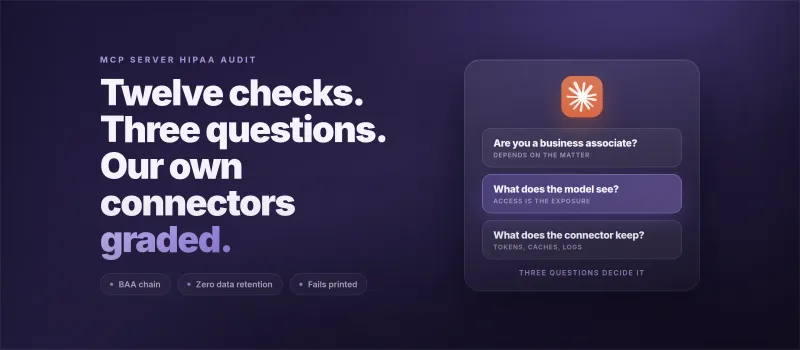
Nobody certifies MCP servers for HIPAA, and nobody outside our team has audited ours. This is the 12-point checklist we run on our own Clio, MyCase and IntakeQ connectors, the business associate test that depends on matter type, the BAA chain from a real defense-firm deal, and the grades our connectors get today, fails included.
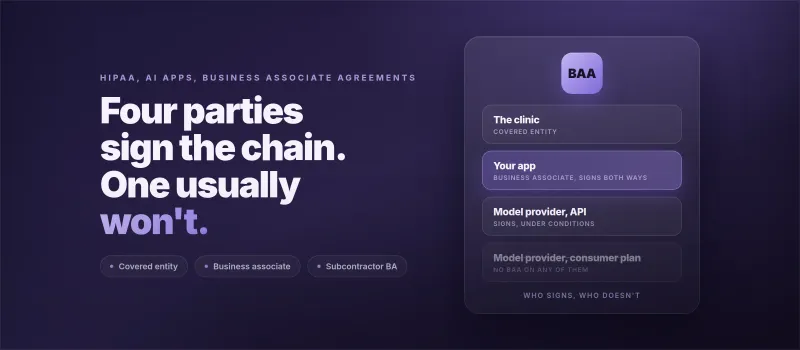
Four parties sit in the BAA chain of an AI healthcare app: the covered entity, your app as business associate, the cloud, and the model provider. The model provider signs on API and enterprise tiers under conditions, and on none of the consumer plans. Vendor terms verified 27 August 2026, the mistake we made on a June call, and the architecture that needs fewer signatures.
Claude Cowork scheduled tasks run on Anthropic's servers, so a Clio MCP server installed through claude_desktop_config.json is invisible to them. Five ways to run a Claude skill on a schedule, sorted by where the connector has to live, with the trust requirements of each.
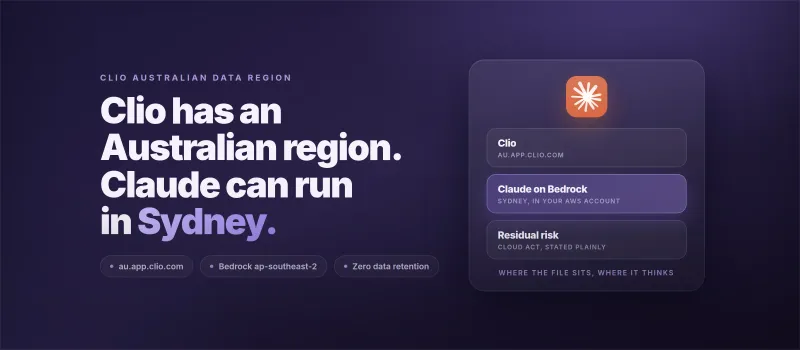
Clio's developer docs list an Australian data region (au.app.clio.com). Claude runs on Amazon Bedrock in Sydney and Melbourne with no storage of inputs or outputs by default. What an Australian law firm can keep in-country, what Sydney does not settle (the CLOUD Act), the model exception, and the region bug in our own connector.
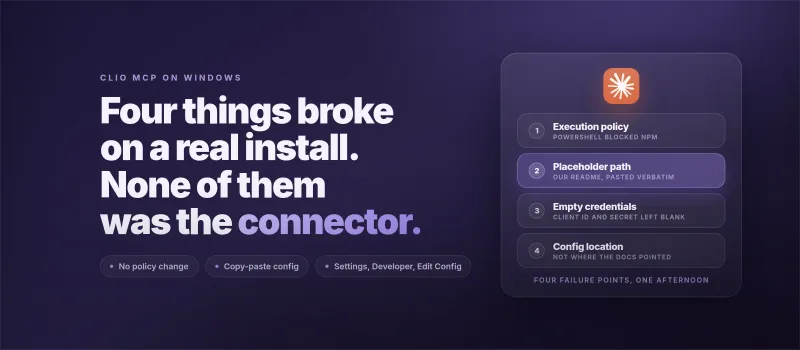
On a live install call in August, our Clio MCP connector hit four failures on a Windows laptop before Claude read a single matter: PowerShell's execution policy blocked npm, a placeholder path from our own README shipped as a real path, empty CLIO_CLIENT_ID and CLIO_CLIENT_SECRET strings, and a Claude Desktop config that wasn't where the docs pointed. Each fix, none of them touching firm IT policy, plus the copy-paste Windows config.
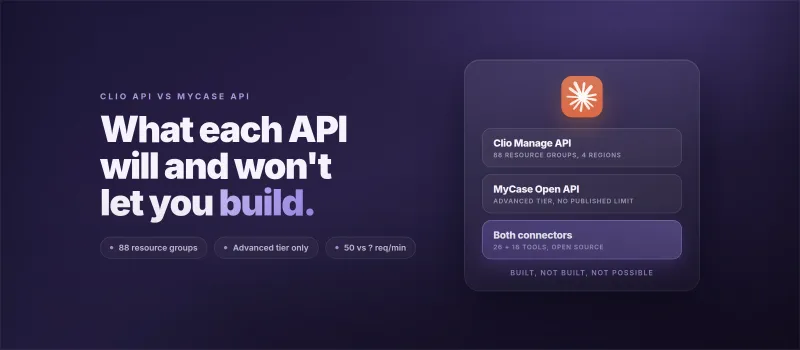
We ship open-source Claude connectors for Clio and MyCase. Clio's API documents 88 resource groups, four data regions, expiring webhooks and a 50-requests-a-minute peak cap; MyCase's Open API is Advanced-tier only, has no email resource and publishes no rate limit. What each lets a firm build, what our connectors cover today, and where 'not built' ends and 'not possible' begins.
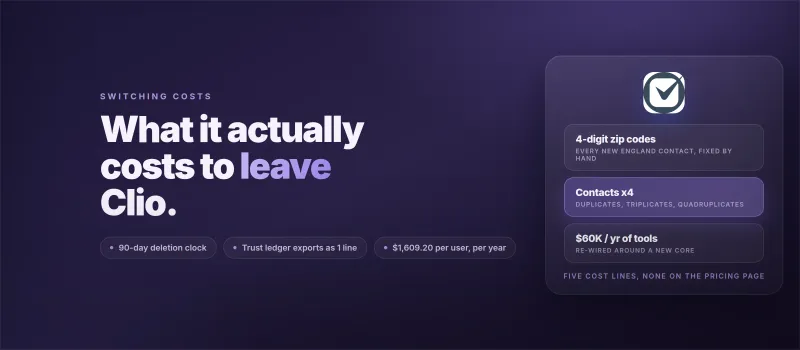
Leaving Clio costs more than the last invoice. Five cost lines from real migrations reported by lawyers: what the export leaves behind, zip codes that lose their leading zero, contacts that arrive in quadruplicate, every connected tool re-wired, and staff time. Plus how Clio's exit terms compare with LEAP and Smokeball, and how to leave without the mess.
iManage has no price list. Reported per-user cost, implementation fees, a 17-person firm's 3-year total, and how it compares with NetDocuments, M-Files, Clio and Harvey.
A 17-person law firm compared iManage against a search platform it would own and run on its own servers: $50-75 per seat versus $0, a vendor cloud versus its own hardware, 8-second searches versus under 100 ms across 1M+ documents. What iManage does well, where the bill and the lock-in bite, what owning the search layer means, the numbers side by side, and the three kinds of firm that should choose differently.
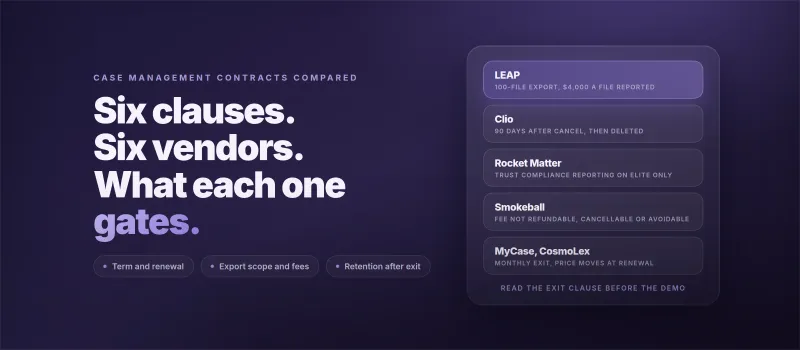
Six practice management contracts read clause by clause on 27 August 2026: term length, auto-renewal, price-change rights, export scope and fees, data retention after cancellation, and API access. Clio's 90-day deletion clock, Smokeball's fee that is 'not refundable, cancellable, or avoidable', Rocket Matter's trust compliance reporting on the $145 tier, LEAP's 100-file export cap and the $4,000-per-file quote users report, and two list prices that moved since spring.
Lawmatics scores 4.6 on G2 and Capterra. Reviewers praise the automations and support, and report slow setup, missing reports, and a price nobody publishes. A real 9-attorney firm pays $1,800/month, $200 per head. Sourced quotes, the demo-call numbers, and the API the review sites skip.
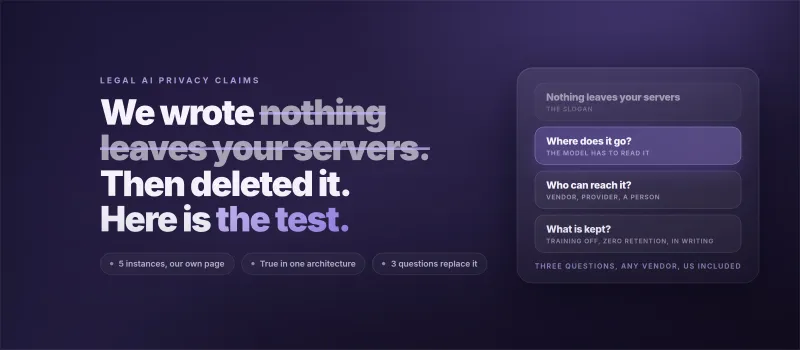
Our own Serbian hub page sold 'the data does not leave the office' as the reason to pick our AI work, one click from a post that calls that claim untrue for any hosted model. Five corrections later: the one architecture where the claim is true, the three questions that replace it, the access vs retention gap, and a vendor test you can run on anyone, including us.
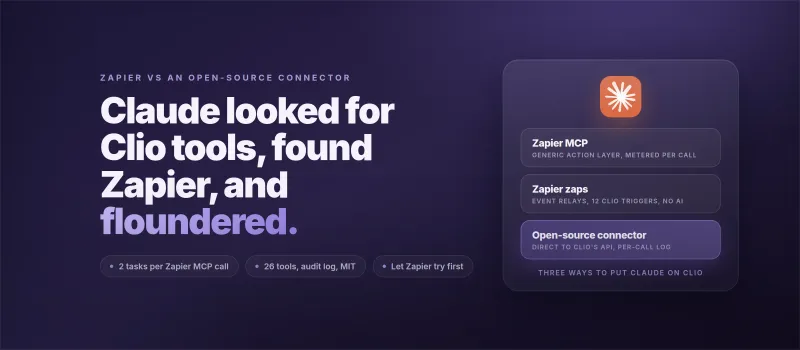
On an August install call, Claude went looking for Clio tools, found Zapier, and floundered in front of the buyer. What a Zapier zap does well for Clio, what Zapier MCP charges per tool call, what a 26-tool open-source connector does and doesn't do yet, and which questions to ask any of the three.
Every way to connect Claude, ChatGPT or Copilot to Jobber as of August 2026: a $47/month hosted server, Zapier MCP, Pipedream, viaSocket and 14 open-source GitHub repos, compared feature by feature, with what each costs and the rate-limit problem almost all of them ship wrong.
Five companies that genuinely take over failed, abandoned, or broken software projects, compared by rescue type, process, and published economics. Includes the verification step most buyers skip: checking whether a rescue shop's domain age matches its claimed history.
Clio Certified Consultants and Clio developers are two different disciplines with two different Clio programs behind them. A job-by-job routing guide: when your firm needs a CCC for setup, migration, and training, and when it needs a developer for API, integration, and AI work.
Firms run Lawmatics for intake and Clio for production, paying twice for contacts, intake forms, e-signature, and billing. What the native integration syncs, what a real 9-attorney firm pays (~$1,800/mo for Lawmatics alone), and an honest framework for when consolidation beats the two-system stack.
The best legal software development companies for law firms in 2026, compared on legal proof, Clio and MyCase integration, compliance and minimums.
Step-by-step setup for the Lawmatics MCP connector, from the team that built it. The api@lawmatics.com email that unlocks Developer Settings, the one-time auth command, the exact Claude Desktop JSON, the read-only flag for cautious firms, and the four errors that account for most failed installs.
The honest breakdown for firms on Lawmatics: what Zapier's Lawmatics integration actually covers (and the custom fields, invoices, pipelines, and tasks it skips), what a 37-tool MCP server does differently, what each costs at real usage, and when you should run both.
Lawmatics lists at $199-$299/month flat. A real 9-attorney firm we spoke with pays $1,800/month. Here is how the sticker becomes the bill: Time & Billing seats, QualifyAI, SMS packs, implementation fees, and the 3-year total.
Lawmatics reporting past the native dashboards: what the CSV export omits, why Zapier drops your custom fields, and how the API and MCP route handles the cross-tabs the built-in reports can't. Real constraints from the team behind the open-source Lawmatics MCP connector.
A decision framework for law firms whose software is slowing cases, creating compliance gaps, or holding the practice hostage. What rescue involves, what replacement involves, and what the recovery actually looks like from firms that have been through it.
Filevine reporting past the native Report Builder: Data Connector CSV exports, DataBridge on Snowflake, the REST API, and plain-English querying via MCP. Real constraints, rate limits, and which pathway fits which firm, from the team that shipped the open-source Filevine MCP connector.
Clio Work is Clio's AI workspace with Vincent inside it. Claude writes better and sees none of your Clio. The open-source Clio MCP connector puts Claude on live matters, with a local log.
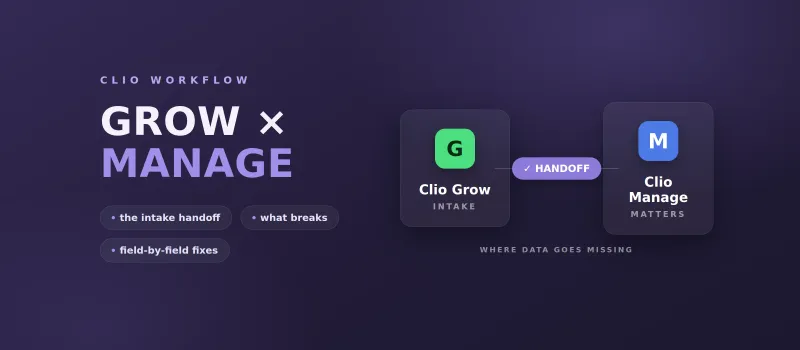
Clio Grow captures the lead, Clio Manage runs the case, and the conversion between them is a per-matter click in the Grow UI. Here is what firms lose in that gap, why they hire implementation specialists at $20 to $55 an hour to patch it, and what an API-level handoff actually takes.
Read article
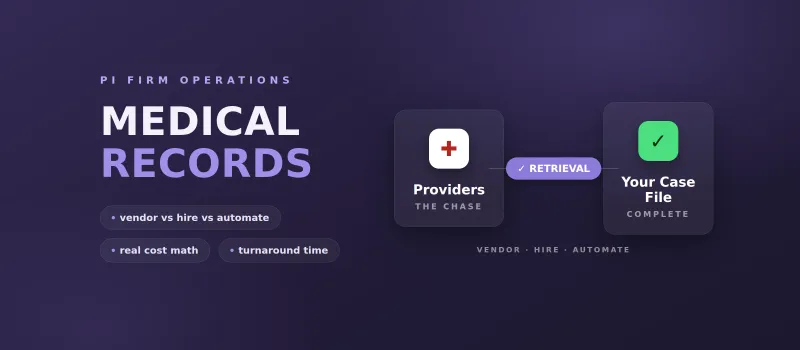
Records chasing is a full job at most personal injury firms: crash reports, FOIL requests, provider follow-ups, preservation letters, and a 90-day municipal notice clock. Here is what a retrieval vendor, a dedicated hire, and an automated request loop each actually cover, and the parts none of them fix.
Read article
Three-way reconciliation means the bank statement, the trust ledger, and every client ledger agree. Doing it across Clio Manage, a payment processor, and QuickBooks Online means reconciling three systems that each believe something slightly different. Here is where the breaks happen and which ones are worth automating.
Read article
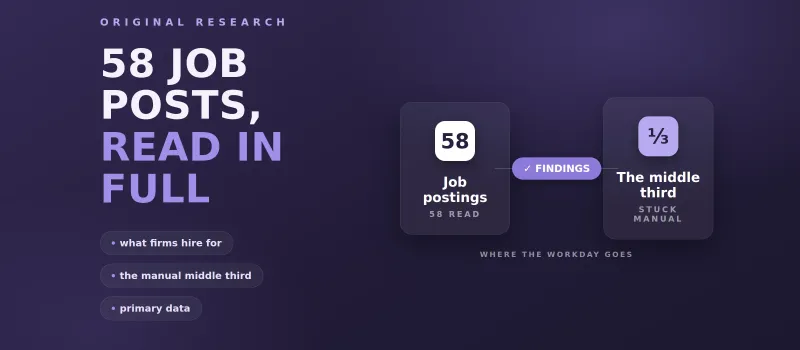
We read every job posting mentioning Clio on one freelance marketplace in July 2026. Zero fixed-price projects above $5,000. Fifty-seven percent of the listings were requests for a human to do work software could do. Here is the full inventory of manual legal work, the rates firms pay for it, and which parts a machine can honestly take.
Read article
The first open-source MCP connector for IntakeQ and PracticeQ. Claude reads your clients, appointments, intake forms, notes, and invoices directly through your IntakeQ account. Every PHI access is logged locally. BAA included on every IntakeQ plan.
A Brooklyn attorney compared both before calling us. Here is the honest breakdown: what Zapier's MyCase integration actually does, what an MCP server does differently, when Zapier is the right choice, and what each means for privileged client data.
Read article
A law firm configured for zero data retention gets a hard error on every request to Claude Fable 5, and on AWS Bedrock that model requires 30-day retention plus opt-in human review. The compliance posture that protects privileged work now carries a capability ceiling. What that means when you pick a model.
Your app launched, people signed up, and now it keeps falling over. Five things usually break once real users show up: slow tables, duplicate charges, database locks, a backed-up job queue, and bugs that now hit everyone at once. What causes each one, and what it takes to sort out.
Read article
Step-by-step setup for the Clio MCP connector, from the team that built it. The Clio developer app path that actually works, the redirect URI trap, the TRANSPORT flag that silently breaks the install, and the Clio plan tier that blocks integrations entirely.
What Clio's native export actually covers, what only the API can reach, and how firms build automated Clio backups to OneDrive or SharePoint with mirrored folder structure and incremental sync.
Read article
Clio notified customers its LawPay integration concludes August 2026. Switching to Clio Payments handles the payment side. Whether your billing draft workflow is still worth fixing is a different question.
Read article
Clio's calendar is fine for one person and strains in two places: staying in sync with Outlook or Google, and answering when several attorneys are all free at once. Here is how Clio's calendar actually works, why the sync feels off, and how firms solve the team-availability problem Clio cannot do natively.
Read article
A free, MIT-licensed MCP connector that lets Claude work with your IntakeQ/PracticeQ data. It ships with the honest part most vendors skip: with a hosted model, PHI still reaches the model. Here is the access vs retention distinction that changes how you evaluate it.
A single medical chronology can take 15 to 80 hours, and a 40-case firm can spend roughly $17,600 a month reviewing records by hand. Here is how litigation teams use Claude on the documents already in Clio to draft chronologies, deposition summaries, and paid-versus-incurred analyses, and the honest line between what a connector does and what has to be built.
Read article
Claude Team vs Enterprise for a law firm: the bill at 2, 5, 10 and 20 people, the 20-seat floor, who sees spend, and where Pro, Max and the API fit. Checked Nov 2026.
Read article
Every privilege-safe AI option for a law firm collapses into three architectural tiers: self-hosted open-weight, a commercial frontier model under Zero Data Retention and a BAA, or a packaged legal AI product. A vendor-by-vendor comparison of training, retention, BAA, ownership, and real cost across Claude, OpenAI, Azure, Gemini, Harvey, CoCounsel, and Clio Duo.
When does building custom case management software beat renting Clio or MyCase per seat? The honest break-even math, what you gain, what you give up, and when to stay put.
Where Filevine and SmartAdvocate earn their keep for PI firms, where they cost you, and the two ways to own more of your workflow: AI on top of Filevine, or a custom build.
MyCase shipped an Open API, then gated it behind its top tier and tells firms to hire a certified consultant for the actual work. Here is what the Open API really does, the three honest ways to integrate it, and how to keep client data privileged while you do.
Read article
Inheriting another vendor's half-built code with a compliance deadline looming? Generic rescue advice says spend months understanding the code. In a regulated system that order is backwards. Here is the liability-first takeover playbook, from a federal-deadline rescue shipped in 8 weeks.
Read article
An honest field guide to the custom software shops that actually build for HIPAA, ABA, and other regulated workloads. Six firms compared on vertical focus, team model, compliance posture, project floor, and who each one is genuinely the right pick for.
Two federal courts ruled on AI and privilege in the same week of February 2026 and reached opposite results. In United States v. Heppner the AI outputs were not privileged; in Warner v. Gilbarco the work product was protected. Here is what actually separated the two, and the architecture questions every firm should answer before running client data through Claude or ChatGPT.
Claude for Legal explained for lawyers: the 12 plugins, the connectors, what it costs on each Claude plan, Clio and MyCase, and what happens to client data.
"HIPAA compliant AI" is not a product you buy. It is an architecture and a process. The model is rarely the variable. The surface, the BAA, retention, access controls, the audit trail, and human review are. Here is a vendor-agnostic breakdown of what actually makes an AI workflow HIPAA-compliant, and a checklist to run before any PHI touches a model.
Your legal team wants AI search that respects document-level permissions and logs every query. Here's how the main approaches handle access control and audit, and how to build search that enforces ethical walls at 100ms on 1M+ documents.
How to connect Claude to Clio and Zoom for law firm automation: the real API behaviors, rate limits, and failure modes we hit building the Clio and MyCase MCP connectors. ZDR, Canadian data residency, and the LSO/ABA-512 human-review duty.
An honest map of what Claude can and can't do with Clio, MyCase, and Zoom in 2026, based on the MCP connectors we built. Real API limits, the custom-field trap, ZDR on API vs Team, and the human-review duty under ABA-512.
Read article
How to let Claude write to Clio, MyCase, or PracticePanther without trusting it blindly: read-first design, scoped writes, confirm gates, dry-run previews, and append-only audit logs. Real API behavior and failure modes from building MCP connectors. Updated October 2026 with what MyCase's official write beta does and does not do.
ZDR is not available on Claude Team or Pro chat. It is available on the Anthropic API at the organization level, which a small firm can obtain. Here is the real difference between the chat tiers and the API, why a Canadian or healthcare firm hits a residency wall, and the architecture we use to keep privileged data off retention.
How to normalize thousands of Clio records without getting throttled. The 50 req/min rate limit, 429 backoff, resumable batch design, the value-instance-id trap that breaks custom-field writes, and a production report on what fails silently under sustained load.
Clio runs a Canadian region (ca.app.clio.com, PIPEDA). Anthropic has no Canadian Claude region. Here is how Canadian law firms route AI workflows compliantly: ZDR on the API, US-pinned inference, LSO and ABA 512 human review.
The two Clio custom field traps: the id inside custom_field_values is the value-instance id, not the field-definition id, and a picklist read returns the option id rather than its label unless you request picklist_option. Plus the field-type limits, upload, webhook and rate-limit gotchas we hit building our Clio MCP connector.
How document upload actually works in the Clio Manage API: the POST /documents then PUT-to-S3 then PATCH fully_uploaded sequence, why a single multipart POST fails, and the real gotchas we hit building our Clio MCP connector.
Clio has no document webhook. If you want to fire automation the moment a document generates in a matter, here's what actually works: matter updated webhooks, polling, and the presigned-S3 upload flow. Lessons from building the Clio MCP connector.
Choosing between Clio and MyCase for Claude-powered legal automation? We shipped MCP connectors for both. Here are the real API differences, rate limits, webhook gaps, custom-field traps, and data-residency facts that decide the build.
Should a regulated firm run its Clio or MyCase AI automation locally or on a hosted server? The honest trade-offs on data residency, audit trails, and scale, learned from building the Clio and MyCase MCP connectors and hitting the API gotchas ourselves.
A side-by-side read of the Law Society of Ontario's AI guidance and ABA Formal Opinion 512 for lawyers using generative AI. Confidentiality, competence, supervision, mandatory human review, billing, and the cross-border data-residency problem when your model has no Canadian region.
Read article
A working build recipe for law firms: take a Zoom consult recording plus the matter notes in Clio, draft a standardized consult memo with Claude, and upload it back into the right matter. Real API behaviors, exact rate limits, and the failure modes we hit building the Clio and MyCase MCP connectors.
Read article
A working recipe for automating legal intake: pull a Zoom consult transcript, extract parties and deadlines, draft a matter shell plus tasks in Clio, and stop at a human-confirm gate. Real API behavior, exact rate limits, and the failure modes we hit building the Clio and MyCase MCP connectors.
A step-by-step recipe for normalizing inconsistent Clio custom field values in place via the Manage API. The value-instance-id trap, field-type rules, the ~3 req/s rate limit, dry-run and rollback, and where Claude fits. Hard-won from building our Clio MCP connector.
Read article
How to automate matter routing and conflict checks across a network of independent lawyers without merging their files. A per-user isolation pattern we learned building the Clio and MyCase MCP connectors: real API limits, the value-id trap, ZDR, and the human-review gate.
A working build recipe for law firms: your practice-management system already generates empty document templates, and the rich data already lives in your custom fields. Here's how to wire Claude to pre-fill those drafts from structured field values, with the real Clio API behavior, rate limits, and failure modes we hit building our open-source connectors.
Read article
Building a Zoom-to-Clio automation and hit a wall reading the AI Companion meeting summary from a Server-to-Server OAuth app? Here's why the read scope is blocked, when you need a General app instead, and why the cloud-recording VTT transcript is the reliable backbone.
Read article
How to auto-trigger a workflow when a Zoom call ends without exposing a public endpoint. Local polling of the Zoom recordings API, the VTT transcript backbone, the AI Companion summary trap, and how this connects to Clio. Lessons from building our Clio and MyCase MCP connectors.
Every gotcha we hit installing the MyCase MCP connector on Windows, including the SSL certificate fix, OAuth port mismatch, and the 13-business-day MyCase credential timeline nobody documents. Step-by-step with the exact config that works.
Five ways to integrate Claude AI with MyCase practice management in 2026. Open-source MCP connector, Clerx AI, Smith.ai, Zapier, and custom builds, compared honestly on cost, compliance, and capability.
Most telemedicine practices back into a headless EHR by duct-taping a patient layer onto Healthie with no-code tools. Here's what building it properly takes.
Zapier and n8n automate a healthcare practice fast, until they break at scale or move PHI through a tool with no BAA. Where the line is, and what to own.
The first open-source MCP connector for MyCase. Connect Claude directly to your MyCase cases, contacts, tasks, documents, calendar, and billing, without sending client data to AI training. ABA Opinion 512 audit logging baked in.
8am MyCase costs $50 Basic, $100 Pro, $130 Advanced per user per month on annual billing, checked 16 October 2026 (up from $39, $89, $109). Accounting is another $39 per user, cards go through LawPay at 2.99% plus 30 cents, the Open API is Advanced only. A 15-attorney firm pays about $146,000 to $165,000 over three years.
AI tooling collapsed the cost of writing fluent software development proposals. Here is how to filter candidates with seven questions that produce answers AI cannot fake, plus the paid scoping path serious buyers are using in 2026.
Read article
Horizontal 'chat with your business' AI products keep raising rounds and keep getting absorbed or shut down. The reason they can't enter regulated industries is structural: ABA Opinion 512, HIPAA BAAs, and the gap that multi-model routers cannot close. Here's the data and what wins instead.
Vibe coding gets you 80% of a product in a weekend. We rescue what's left. Real teardown of one 'MVP Complete' handoff: circular auth, 1,339-line page files, 61 TypeScript errors, all integrations stubbed, zero infrastructure. Here's what it took to make it real.
ABA Formal Opinion 512 (July 2024) sets binding ethics rules for AI on law firm websites. Here's what attorney supervision, disclosure, and UPL prevention look like as design constraints, not just policy.
Most healthcare chatbots don't need to handle PHI at all. Here's the two-architecture decision that determines your entire HIPAA compliance burden, and how to get it right before writing the first line of code.
After United States v. Heppner, consumer Claude is not privilege-safe and Claude Enterprise is an 'open question' per the court. This is the deployment guide for running Claude-quality AI on your firm's hardware with no third-party processor: Llama 4, LM Studio, our open-source Clio MCP connector, ABA Opinion 512 audit logging.
Five open-source Clio MCP connectors exist as of September 2026, plus a hosted, closed-source category that appeared this autumn. They are not interchangeable. A feature-by-feature comparison of tool coverage, compliance, and licensing across LegalContext, lawquarter, LegalMCP, lawyered0, and Oktopeak's Clio MCP server, plus the consultancies and aggregators you will meet in the same search.
Clio publishes a per-user price. The actual 3-year cost for a 15-attorney firm (with AI, QuickBooks, and payment processing) is closer to $112K. Here's the full breakdown.
Read article
A practical guide to building Claude MCP servers for law firms. Connect Claude to Clio, protect attorney-client privilege, and satisfy ABA Opinion 512. Architecture, approaches, and compliance checklist.
Can you outsource HIPAA-compliant software? Yes, but most founders miss critical steps. BAA coverage gaps, PHI in test environments, audit participation, and vendor security evaluation -- from a team that's passed 3 HIPAA audits.
Read article
Data protection laws, IP ownership, contract enforcement, timezone reality, and talent pool quality. Everything a US founder needs to verify before engaging a Serbian development team.
Read article
AI tools generate functional code, not compliant code. This HIPAA checklist covers encryption, audit trails, access controls, PHI handling, and BAAs -- with real project data from rescue engagements.
Read article
The default Lovable and Bolt setup has no path to a BAA: Lovable's DPA bars PHI, and the Supabase and Vercel plans a prototype starts on sign none. Here's what's missing from vibecoded healthcare apps, which plans do sign a BAA, and the path to production.
Read article
You built a legal tool with Claude, Lovable or Cursor. What breaks when other firms use it, what the bar rules require, what drives the cost, and the path.
Most brands are invisible to AI search tools like ChatGPT, Claude, and Perplexity. Here are 6 things that actually work to get your brand cited in AI-generated answers, from robots.txt to structured data to topical authority.
Read article
Most 'AI agent' projects are glorified prompt chains. Here's what real agentic architecture looks like: tool use, memory, planning loops, infrastructure costs, and when you actually need agents vs smart automation. From a team that's shipped AI in production healthcare.
Read article
Chrome extensions are the fastest SaaS distribution channel in 2026. Manifest V3 architecture, cost breakdown ($5K-$50K), backend requirements, and the Chrome Web Store review process. A technical guide for founders.
Read article
Honest technical analysis of Next.js + Supabase for SaaS products. When to use it, when to outgrow it, and the migration path to custom backend. From a team that evaluates stacks for 50+ MVPs.
Read article
Lawyers waste 6 hours per week searching for documents. Here's why growing law firms are replacing generic DMS search with custom Elasticsearch-powered knowledge management, and recovering $220K+/year.
Read article
Why legal tech and healthcare companies need more than basic search. Real architecture decisions for compliance-grade Elasticsearch: audit trails, HIPAA, encrypted indices, and 100ms queries on 1M+ docs.
Read article
Your software project failed. The money's gone, the team's demoralized, and you're not sure what to do next. Here's the founder's playbook for what to salvage, what to learn, and how to rebuild smarter, from a team that rescues failed projects for a living.
Read article
Your software project is going sideways. Missed deadlines, budget overruns, a team that's lost confidence. Here's the 5-step rescue framework that's saved projects worth $50k-$200k, with real decision criteria for when to rescue vs. restart.
Read article
Most MVPs fail before they find a single paying user. Here are 8 real reasons (wrong team, wrong scope, wrong timing) and what to do instead. Based on 50+ MVPs shipped in regulated industries.
Read article
The AI healthcare market hits $67.4B in 2026, but most healthcare AI products fail. Here's what actually works (content generation, intelligent search, classification) with real project examples, HIPAA-AI compliance patterns, and honest cost breakdowns.
Read article
Audit trail implementation guide for HIPAA, DEA, SOC 2, and GDPR compliance. Real architecture patterns from 4 regulated SaaS platforms we shipped, with code examples, anti-patterns, and cost breakdowns.
Read article
How we built DEA-compliant controlled substance tracking software with automated Form 41 generation, biometric auth, and remote video witnessing. Real architecture decisions from a 120-hour build.
Read article
How we built AI-powered legal document search that returns results in 100ms across 1M+ documents. Elasticsearch architecture, document classification, and $220k/year ROI breakdown for law firms.
Read article
How to start a HIPAA-compliant patient portal in 2026. The three paths (EHR built-in, third-party vendor, custom build), FHIR/HL7 integration, real cost tiers from $15k to $90k, and a 5-step implementation guide built on 3 delivered HIPAA platforms.
Read article
Transparent MVP pricing breakdown. What $35k, $50k, and $200k actually buy you in features, architecture, and compliance. Real project budgets from 50+ MVPs shipped across legal tech, healthcare, and operations.
Read article
Build vs buy analysis for enterprise search. Real case study: custom search on 1M+ legal documents at 100ms, saving $220k/year vs Elasticsearch + Algolia. Decision framework, cost comparison, and the search features that off-the-shelf tools can't do.
Read article
How we reduced CSV processing from 20 minutes to under 3 minutes for a multi-location event retail platform managing 500,000+ SKUs. Real architecture decisions, benchmarks, and the sync accuracy problem nobody talks about.
Read article
Technical guide to FDA software validation for healthcare SaaS. 21 CFR Part 11 requirements, IQ/OQ/PQ protocols, electronic signatures, audit trails, and the classification trap that costs startups 6 months. From a team with 3+ regulated healthcare platforms.
Read article
Practical GDPR compliance checklist for SaaS developers. Data mapping, consent management, right to deletion architecture, breach notification systems, and DPA requirements. From a team that builds for regulated industries.
Read article
The 5 most common HIPAA audit failures we see in healthcare SaaS, and how to fix them before an auditor finds them. Real examples from 4+ HIPAA platforms shipped.
Read article

Technical HIPAA implementation guide for developers. Encryption patterns, audit logging architecture, AWS HIPAA setup, RBAC enforcement, and BAA requirements. From a team that's shipped 4+ HIPAA platforms.
Read article
Legal tech trends that matter in 2026: AI document review that works (and doesn't), compliance automation replacing manual workflows, and the search infrastructure gap most legal SaaS still hasn't solved. From a team that's built 3 legal tech platforms.
Read article
Discovery phases exist because the agency hasn't built your product before. After 50+ MVPs in regulated industries, we scope during the first call, not after a $15k discovery engagement. Here's how.
Read article
Your SaaS MVP is broken and your previous dev team disappeared. Here's how to assess, rescue, and relaunch, based on a real project we took from broken prototype to production in 8 weeks. Codebase audit checklist, refactor-vs-rewrite decision framework, and cost estimates.
Read article
Why US SaaS founders hire Serbian developers for regulated industries. CET timezone overlap, $60-80/hr vs $200-300/hr US rates, HIPAA and DEA compliance experience, GDPR-aligned data protection. The cost-quality math for healthcare and legal tech.
Read article
SOC 2 Type 1 vs Type 2 for a young SaaS: what each proves, how long it takes, what audits cost in 2026, and what to send a buyer before you have a report.
After 50+ MVPs shipped, we dropped Scrum. Here's why sprint planning, story points, and standup meetings slow down small teams building regulated SaaS, and the Shape Up-inspired process we use instead.
Read article
How to deploy SaaS updates across multiple locations without downtime. Blue-green deployments, database migrations, feature flags, and the rollback strategy that saved us at 2 AM. Real architecture from a 3-location launch.
Read article
Healthcare SaaS development for founders who need HIPAA-compliant platforms that work. Patient portals, provider tools, telehealth, and EHR integrations. Real projects, real timelines, 8-12 weeks.
Read article
How to build HIPAA-compliant software without burning your budget: the architecture decisions that matter, where compliance work actually goes, and the mistakes that trigger audits. From a team that's shipped 4+ HIPAA platforms.
Read article
Complete cost breakdown of self-hosted ELK vs managed Elasticsearch. Infrastructure, labor, scaling costs compared. Real numbers from consultants who've deployed both.
Read article

Transparent MVP development cost guide with real project budgets. Learn what drives pricing, see actual case studies ($15k-$50k range), and calculate your MVP cost. HIPAA compliance costs included.
Read article

How to build a Continuing Medical Education platform that passes accreditation review. PubMed verification, audit trails, credit tracking, and HIPAA overlap, from a team that shipped one.
Read article
Most LMS gamification fails because it treats professionals like gamers. Here's what actually drives engagement in professional learning platforms, streaks, tiered achievements, and virtual currency that converts.
Read article

AI isn't magic. Here's a practical guide to when AI integration genuinely helps your product, and when it's just an expensive distraction.
Read article
Airtable is great for prototyping, but it wasn't built to run complex operations at scale. Here are 5 signs it's time to move to custom software.
Read article
The most common Elasticsearch mistakes we see in production: wrong mapping types, over-sharding, missing filters, and more. With code examples and fixes.
Read article

Step-by-step guide to optimizing Elasticsearch query performance. Mapping strategies, query patterns, caching, and real examples that achieved 50x speedups.
Read article
Elasticsearch vs OpenSearch comparison for 2026. License differences, performance, features, and when to use each. From consultants who've deployed both.
Read article
Your CSV import crashes at 2,000 rows. Ours handles 10,000 in under 3 minutes. Here's the Laravel queue architecture that makes it work, with real code examples.
Read article
Technical deep-dive: How we achieved sub-100ms query times on 1M+ legal documents using Elasticsearch. Architecture, optimization techniques, and real-world results.

Read article

Card testing fraud cost businesses $1.8B last year. We caught a sophisticated fraud ring and stopped it in 24 hours. Learn the 7-layer defense system we built.
Read article

How we built a HIPAA-compliant structured settlement case management platform in 8 weeks for 290 hours. From discovery to launch, here's the full story.

Read articleNEWSLETTER